Nepal
Bhaktapura (Bhatgaon) Kings¹ 1696 - 1722 Sri Jayabhupatindramalla 1722 - 13 Nov 1769 Jyaranajitamalla Kantipura (Kathmandu)Kings¹ 1687 - 1700 Jayabhupalendramalla (Jayamahipatindramalla) 1700 - 1722 Jayabhaskaramalla (Jayamahendrasimhamalla) 1722 - 1734 Jayajagajjayamalla 1735 - 1746 Jayaprakasamalla (1st time) 1746 - 1752 Jayajyotiprakasamalla 1752 - 25 Sep 1768 Jayaprakasamalla (2nd time) Lalitapura (Lalitapatan)Kings¹ 1684 - 1705 Jayayoganarendramalla 1705 - 1706 Jayalokaprakasamalla 1706 - 1709 Jayendramalla 1709 Jayamahendramalla (1st time) 1709 Jayaviranarasimhamalla 1709 - 1714 Jayamahendramalla (2nd time) 1715 - 1717 Jayariddhinarasimhamalla 1717 - 1722 Jayabhaskaramalla (Jayamahendrasimhamalla) 1722 - 1729 Jayayogaprakasamalla 1729 - 1745 Sri Jayavishnumalla 1745 - 1758 Jayarajyaprakasamalla 1758 - 1760 Jayavisvajitmalla 1760 - 1762 Jayaprakasamalla (1st time) 1762 - 1763 Jayaranajitmalla 1763 Jayaprakasamalla (2nd time) 1764 - 1765 Dalamardana Saha (usurper, Saha dynasty of Gorkha) 1765 - Oct 1768 Jayatejanarayanasimhamalla GorkhaRajas 1669 - 1716 Prithvipati Saha (d. 1716) 1716 - 1742 Narabhpati Saha (d. 1742) 1742 - 25 Sep 1768 Prithvinarayana Saha (b. 1723 - d. 1775) Nepal Kings (title Maharajadhiraja) 25 Sep 1768 - 11 Jan 1775 Prithivi Narayan Shah Deva (s.a.) 11 Jan 1775 - 17 Nov 1777 Sinha Pratap Shah Deva (b. 1751 - d. 1777) 17 Nov 1777 - 23 Mar 1799 Rana Bahadur Shah Deva (b. 1775 - d. 1806) 17 Nov 1777 - 31 Aug 1778 Queen Rajendra Lakshmi -Regent (d. 1785) (1st time) 2 Sep 1778 - 20 Jun 1779 Bahadur Shah -Regent (1st time) (b. 1757 - d. 1797) 20 Jun 1779 - 13 Jul 1785 Queen Rajendra Lakshmi -Regent (s.a.) (2nd time) 13 Jul 1785 - 6 Jun 1794 Bahadur Shah -Regent (2nd time) (s.a.) 23 Mar 1799 - 20 Nov 1816 Girvan Yuddha Bikram Shah Deva (b. 1797 - d. 1816) 23 Mar 1799 - Apr 1800 Queen Rajeshwari Devi -Regent (b. 17.. - d. 1806) (f) (1st time) Apr 1800 - 1802 Subarna Prabha Devi (f) -Regent (b. 17.. - d. 1806) 1802 - 1804 Queen Rajeshwari Devi -Regent (s.a.) (f) (2nd time) 1804 - 25 Apr 1806 Rana Bahadur Shah Deva -Regent (s.a.) 25 Apr 1806 - 6 Apr 1832 Queen Lalit Tripura Sundari -Regent(b. 1794 - d. 1832) 20 Nov 1816 - 12 May 1847 Rajendra Bikram Shah Deva (b. 1813 - d. 1881) 5 Jan 1843 - Nov 1846 Rajya Lakshmi Devi (f) -Regent 12 May 1847 - 17 May 1881 Surendra Bikram Shah Deva (b. 1829 - d. 1881) 17 May 1881 - 11 Dec 1911 Prithivi Bir Bikram Shah Deva (b. 1875 - d. 1911) 17 May 1881 - 8 Aug 1893 Queen Lalita Rajya Lakshmi Devi (f) -Regent 11 Dec 1911 - 7 Nov 1950 Tribhuvana Bir Bikram Shah Deva (b. 1906 - d. 1955) (1st time) (in India exile 7 Nov 1950 - 7 Jan 1951) 11 Dec 1911 - c.1918 Queen Revati Raman Rajya Lakshmi (b. 1878 - d. 1926) Devi (f) -Regent 7 Nov 1950 - 7 Jan 1951 Gyanendra Bir Bikram Shah Deva (b. 1947) (1st time) 7 Jan 1951 - 13 Mar 1955 Tribhuvana Bir Bikram Shah Deva (s.a.) (2nd time) 14 Mar 1955 - 31 Jan 1972 Mahendra Bir Bikram Shah Deva (b. 1920 - d. 1972) 31 Jan 1972 - 1 Jun 2001 Birendra Bir Bikram Shah Deva (b. 1945 - d. 2001) 1 Jun 2001 - 4 Jun 2001 Dipendra Bir Bikram Shah Deva (b. 1971 - d. 2001) 4 Jun 2001 - 28 May 2008 Gyanendra Bir Bikram Shah Deva (s.a.) (2nd time) (regent for Dipendra 2-4 Jun 2001; suspended from 15 Jan 2007)Presidents15 Jan 2007 - 23 Jul 2008 Girija Prasad Koirala (b. 1925 - d. 2010) NCP (acting head of state) 23 Jul 2008 - Ram Baran Yadav (b. 1947) NCP Prime ministers 1799 - 1804 Damodar Pande (b. 17.. - d. 1804) 1804 - 25 Apr 1806 Rana Bahadur Shah Deva (s.a.) Apr 1806 - 1837 Bhimsen Thapa (b. 1775 - d. 1839) 1837 Rana Jang Pande (1st time) (d. 1843) 1837 - 1838 Ranga Nath Poudyal (1st time) 1838 - 1839 Puskar Shah 1839 - 1840 Rana Jang Pande (2nd time) (s.a.) 1840 Ranga Nath Poudyal (2nd time) Nov 1840 - Jan 1843 Fateh Jang Chautaria (1st time) (b. 1805 - d. 1846) 28 Nov 1843 - 17 May 1845 Madhabar Singh Thapa (b. 1798 - d. 1845) Sep 1845 - 14 Sep 1846 Fateh Jang Chautaria (2nd time) (s.a.) 15 Sep 1846 - 1 Aug 1856 Jang Bahadur Kunwar (1st time) (b. 1817 - d. 1877) (from 5 May 1848, Jang Bahadur Rana) 1 Aug 1856 - 25 May 1857 Bam Bahadur Kunwar Rana (b. 1818 - d. 1857) 25 May 1857 - 28 Jun 1857 Krishna Bahadur Kunwar Rana (b. 1823 - d. 1863) (acting) 28 Jun 1857 - 25 Feb 1877 Jang Bahadur Rana (2nd time) (s.a.) 27 Feb 1877 - 22 Nov 1885 Ranaudip Singh (b. 1825 - d. 1885) Non-party 22 Nov 1885 - 5 Mar 1901 Bir Shamsher Jang Bahadur Rana (b. 1852 - d. 1901) Non-party 5 Mar 1901 - 27 Jun 1901 Deva Shamsher Jang Bahadur Rana (b. 1862 - d. 1914) Non-party 27 Jun 1901 - 26 Nov 1929 Chandra Shamsher Jang Bahadur Rana (b. 1863 - d. 1929) Non-party Nov 1929 - 1 Sep 1932 Bhim Shamsher Jang Bahadur Rana (b. 1865 - d. 1932) Non-party 1 Sep 1932 - 29 Nov 1945 Juddha Shamsher Jang Bahadur Rana (b. 1875 - d. 1952) Non-party 29 Nov 1945 - 30 Apr 1948 Padma Shamsher Jang Bahadur Rana (b. 1882 - d. 1961) Non-party 30 Apr 1948 - 12 Nov 1951 Mohan Shamsher Jang Bahadur Rana (b. 1885 - d. 1967) Non-party 16 Nov 1951 - 14 Aug 1952 Matrika Prasad Koirala (1st time) (b. 1912 - d. 1997) NCP 14 Aug 1952 - 15 Jun 1953 King Tribhuvana Bir Bikram Shah (s.a.) Non-party Deva 15 Jun 1953 - 14 Apr 1955 Matrika Prasad Koirala (2nd time) (s.a.) RPP 14 Apr 1956 - 27 Jan 1956 King Mahendra Bir Bikram Shah Deva (s.a.) Non-party 27 Jan 1956 - 26 Jul 1957 Tanka Prasad Acharya (b. 1912 - d. 1992) NPP 26 Jul 1957 - 15 Nov 1957 Kunwar Indrajit Singh (b. 1906 - d. 1982) UDP 15 May 1958 - 27 May 1959 Subarna Shamsher Jang Bahadur Rana (b. 1910 - d. 1977) Non-party 27 May 1959 - 15 Dec 1960 Bishweshwar Prasad Koirala (b. 1914 - d. 1982) NCP 15 Dec 1960 - 2 Apr 1963 King Mahendra Bir Bikram Shah Deva (s.a.) Non-party (1st time) 26 Dec 1960 - 23 Dec 1963 Tulsi Giri (1st time) (b. 1926) Non-party (first minister to 2 Apr 1963) 23 Dec 1963 - 26 Feb 1964 Surya Bahadur Thapa (1st time) (b. 1928) Non-party 26 Feb 1964 - 26 Jan 1965 Tulsi Giri (2nd time) (s.a.) Non-party 26 Jan 1965 - 7 Apr 1969 Surya Bahadur Thapa (2nd time) (s.a.) Non-party 7 Apr 1969 - 13 Apr 1970 Kirti Nidhi Bista (1st time) (b. 1927) Non-party 13 Apr 1970 - 14 Apr 1971 King Mahendra Bir Bikram Shah Deva (s.a.) Non-party (2nd time) 13 Apr 1970 - 14 Apr 1971 Gehendra Bahadur Rajbhandari (b. 1923 - d. ....) Non-party (first minister) 14 Apr 1971 - 16 Jul 1973 Kirti Nidhi Bista (2nd time) (s.a.) Non-party 16 Jul 1973 - 1 Dec 1975 Nagendra Prasad Rijal (1st time) (b. 1927 - d. 1994) Non-party 1 Dec 1975 - 12 Sep 1977 Tulsi Giri (3rd time) (s.a.) Non-party 12 Sep 1977 - 30 May 1979 Kirti Nidhi Bista (3rd time) (s.a.) Non-party 30 May 1979 - 12 Jul 1983 Surya Bahadur Thapa (3rd time) (s.a.) Non-party 12 Jul 1983 - 21 Mar 1986 Lokendra Bahadur Chand (1st time) (b. 1940) Non-party 21 Mar 1986 - 15 Jun 1986 Nagendra Prasad Rijal (2nd time) (s.a.) Non-party (acting) 15 Jun 1986 - 6 Apr 1990 Marich Man Singh Shrestha (b. 1942) Non-party 6 Apr 1990 - 19 Apr 1990 Lokendra Bahadur Chand (2nd time) (s.a.) Non-party 19 Apr 1990 - 26 May 1991 Krishna Prasad Bhattarai (1st time)(b. 1924 - d. 2011) NCP 26 May 1991 - 30 Nov 1994 Girija Prasad Koirala (1st time) (s.a.) NCP 30 Nov 1994 - 12 Sep 1995 Man Mohan Adhikari (b. 1920 - d. 1999) CPN-UML 12 Sep 1995 - 12 Mar 1997 Sher Bahadur Deuba (1st time) (b. 1946) NCP 12 Mar 1997 - 7 Oct 1997 Lokendra Bahadur Chand (3rd time) (s.a.) RPP 7 Oct 1997 - 15 Apr 1998 Surya Bahadur Thapa (4th time) (s.a.) RPP 15 Apr 1998 - 31 May 1999 Girija Prasad Koirala (2nd time) (s.a.) NCP 31 May 1999 - 22 Mar 2000 Krishna Prasad Bhattarai (2nd time)(s.a.) NCP 22 Mar 2000 - 26 Jul 2001 Girija Prasad Koirala (3rd time) (s.a.) NCP 26 Jul 2001 - 4 Oct 2002 Sher Bahadur Deuba (2nd time) (s.a.) NCP 4 Oct 2002 - 11 Oct 2002 King Gyanendra Bir Bikram Shah (s.a.) Non-party Deva (1st time) 11 Oct 2002 - 5 Jun 2003 Lokendra Bahadur Chand (4th time) (s.a.) RPP 5 Jun 2003 - 3 Jun 2004 Surya Bahadur Thapa (5th time) (s.a.) RPP 3 Jun 2004 - 1 Feb 2005 Sher Bahadur Deuba (3rd time) (s.a.) NCP 1 Feb 2005 - 30 Apr 2006 King Gyanendra Bir Bikram Shah (s.a.) Non-party Deva (2nd time) 30 Apr 2006 - 18 Aug 2008 Girija Prasad Koirala (4th time) (s.a.) NCP 18 Aug 2008 - 25 May 2009 Pushpa Kamal Dahal "Prachanda" (b. 1954) CPN-M 25 May 2009 - 6 Feb 2011 Madhav Kumar Nepal (b. 1953) CPN-UML 6 Feb 2011 - Jhalanath Nath Khanal (b. 1950) CPN-UML British Residents 1802 - 1803 Knox 1803 - 1816 Vacant 1816 Boileau (acting) 1816 - 1829 Edward Gardiner 1829 - 1831 Brian Houghton Hodgson (1st time) (b. 1800 - d. 1894) (acting) 1831 - 1833 Thomas Herbert Maddock (b. 1790 - d. 1870) 1833 - 1843 Brian Houghton Hodgson (2nd time) (s.a.) 1843 - 1845 Henry Lawrence (b. 1806 - d. 1857) 1845 - 1847 John Russell Colvin (b. 1807 - d. 1857) 1847 - 1850 C. Thoresby 1850 - 1852 James Claudius Erskine (b. 1821 - d. 1893) 1852 - 1867 George Ramsay 1867 - 1872 Richard Charles Lawrence (b. 1817 - d. 1896) 1872 - 1888 Charles E.R. Girdlestone 1888 - 1891 Edward Law Durand (b. 1845 - d. 1920) 1891 - 1899 Henry Wylie (b. 1844 - d. 1918) 1899 A.M. Muir 1899 - 1901 William Loch (b. 1845 - d. 1912) 1901 - 1902 T. Pears 1902 - 1905 Charles Withers Ravenshaw (b. 1851 - d. 1935) 1905 - 1916 John Manners Smith (b. 1864 - d. 1920) 1916 - 1918 Steuart Farquharson Bayley (b. 1863 - d. 1938) 1918 - 1923 William Frederick Travers (b. 1870 - d. 1943) O'Connor (from 1920, Envoy) ¹Style of Licchavi rulers from c.1200: Rajadhiraja Paramesvara Paramabhattaraka Sri Sri N.N. Vijayarajye Nepala. Territorial Disputes: Joint border commission continues to work on contested sections of boundary with India, including the 400 square kilometer dispute over the source of the Kalapani River; India has instituted a stricter border regime to restrict transit of Maoist insurgents and illegal cross-border activities; approximately 106,000 Bhutanese Lhotshampas (Hindus) have been confined in refugee camps in southeastern Nepal since 1990. Party abbreviations (political parties banned 15 Dec 1960 - 19 Apr 1990): CPN-M = Communist Party of Nepal - Maoist (communist, Marxist-Leninist-Maoist, est.1995); CPN-UML = Nepal Kamyunist Parti - Ekikrit Marksvadi ra Leninvadi (Communist Party of Nepal-Unified Marxist-Leninist, communist, est.1991); NCP = Nepalese Congress Party (social-democratic, anti-Rana, leftist, est.1950); RJP = Rastriya Janata Parishad (National People's Council); - Former parties: NPP = Nepal Praja Parishad (Nepal People's Council, anti-Rana, social-democratic, 1936-1960); RPP = Rastriya Praja Party (National People's Party, conservative, est.by B.P. Koirala, 1953-59); UDP = United Democratic Party Mustang (Mastang)
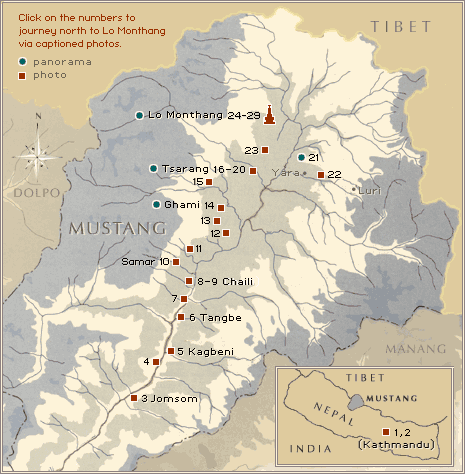
c.1350 Kingdom of Mastang under the alternating suzerainty of Tibet and Jumla (from 1789, Nepal). 1544 - 1560 Occupied by Jumla. 5 Oct 1961 Nepal-China boundary treaty confirms inclusion within Nepal. 7 Oct 2008 Traditional kingship abolished by Nepal. Kings (title Glo rgyal-po) 1656 - 1710 Sa-dbang (b. c.1639 - d. 17..) 1711 - 1723 Tshe-dbang (Je Ang) (d. bf.1725) 1723 - c.1728 bKra-shis-rnam-rgyal (d. c.1728) (Krathis Namgyal) c.1728 - c.1750 bsTan-'dzin-dbang-rgyal (b. c.1717 - d. c.1750) (Tenzing Anjia) c.1728 - 1734 Nor-dzin bde-legs (d. af.1735) dbang-mo (f) -Regent c.1750 - 1797 dBang-rgyal-rdo-rje (Anjia Dorje) (b. c.1738 - d. 1797) 1797 - 1815 bKra-shis-sñin-po (Krathis Ningpo) 1815 - 1837 'Jam-dpal-dgra-'ldus (d. 1837) (Jampel Traldus) 1837 - 1857 Kun-dga'-nor-bu (Kunga Norbu) (d. 1857) 1857 - 1863 'Jam-dbyangs-dban-'dus (d. 1863) (Jamian Angdu) 1857 - 1863 rGyal-mo bKra-shis bu-khrid (f) -Regent 1863 - 1893 dNgos-grub-dpal-'bar (d. 1893) 1863 - 1868 rGyal-mo Tshe-mchog (d. 1871) sGrol-ma (f) -Regent 1893 - 1935 'Jam-dbyangs-dpal-'bar (d. 1935) (Jambian Pelbar) 1935 - 1955 A-mgon-bsTan-'dzin-dgra-'dul (b. 1923 - d. 1964) (1st time)(Angun Tenzing Trandul) 1955 - 1958 A-ngdu-sñin-po (Angdu Nyingpo) (b. 19.. - d. 1958) 1958 - 1964 A-mgon-bsTan-'dzin-dgra-'dul (s.a.) (2nd time) 1964 - 7 Oct 2008 'Jigs-med-rdo-rje-dgra-'dul (b. 1930) ('Jigs-med-dpal-'bar Bista) (Jigme Pelbar Bista) ©2000 Ben Cahoon | |||||||||||||||||||||||||||||||||||||||||||||||||||||||||
Monday, May 30, 2011
nepal
![[Nepal Flag of the Kings c.1847-1923]](http://www.worldstatesmen.org/nepal1.gif)
![[Nepal Flag of Hereditary Rana Prime ministers c.1847-1923]](http://www.worldstatesmen.org/nepal2.gif)
![[Nepal Flag 1923-1962]](http://www.worldstatesmen.org/nep_1962.gif)
![[Nepal flag]](http://www.worldstatesmen.org/np.gif)
![[Royal Flag of Mustang (Mastang)]](http://www.worldstatesmen.org/np_mustang.gif)
![[Mastang Royal flag (Nepal)]](http://www.worldstatesmen.org/mustang.gif)

nepal
Languages of Nepal
See language maps.[See also SIL publications on the languages of Nepal.]
Kingdom of Nepal, Sri Nepala Sarkar. 27,094,000. 17,982,769 Indo-European (79.1%), 4,183,995 Sino-Tibetan (18.4%), 40,260 Austro-Asiatic (less than 1%), 28,615 Dravidian (less than 1%), 503,295 not stated (2.2%) (2001 census). National or official languages: Nepali, English. Literacy rate: 54%; 65% males, 42% females (2001 census). Immigrant languages: English, Kharia (1,580), Urdu (175,000). Information mainly from D. B. Bista 1967, 1973, 1996; R. Burling 2003; K. Ebert 1994; A. Hale 1982; R. Hugoniot 1970; J. Matisoff, S. Baron and J. Lowe 1996; S. Toba 1976, 1983, 1991; W. Winter and Hansson 1991. Blind population: 100,000. Deaf population: 1,92,000. Deaf institutions: 3. The number of individual languages listed for Nepal is 126. Of those, 124 are living languages and 2 have no known speakers.
| Angika | [anp] 15,900 in Nepal (2001 census). Terai. Alternate names: Anga, Angikar, Chhika-Chhiki. Classification: Indo-European, Indo-Iranian, Indo-Aryan, Eastern zone, Bihari More information. |
| Athpariya | [aph] 2,000 (1995 K. Ebert), decreasing. 439,312 all Rai languages (1991 census). Kosi zone, Dhankuta District, north of the Tamur, between the Dhankutakhola in the west and the Tangkhuwa in the east; Dhankuta and Bhirgaon panchayats. Alternate names: Arthare, Arthare-Khesang, Ath Paharia Rai, Athapre, Athpare, Athpre, Jamindar Rai. Dialects: Athpare [byw] from Dhankuta and Belhara are very similar, but not mutually inherently intelligible (Bickel 1996). Reportedly similar to Limbu [lif], but not inherently intelligible with it. The term ‘Kiranti’ covers about 21 speech varieties, of which fewer than half are even partially mutually intelligible. Classification:Sino-Tibetan, Tibeto-Burman, Himalayish, Mahakiranti, Kiranti, Eastern More information. |
| Awadhi | [awa] 561,000 in Nepal (2001 census). Lumbini zone, Kapilbastu District; Bheri zone, Banke and Bardiya districts. Alternate names: Abadhi, Abadi, Abohi, Ambodhi, Avadhi, Baiswari, Kojali, Kosali. Dialects: Degauri Tharu, Gangapari, Mirzapuri, Pardesi, Tharu, Uttari. Classification: Indo-European, Indo-Iranian, Indo-Aryan, East Central zone More information. |
| Bagheli | [bfy] Ethnic population: 136,953 Kewat (2001 census). Koshi Zone, Morang District. Alternate names: Bagelkhandi, Bhugelkhud, Gangai, Kawathi, Kenat, Kevat Boli, Kevati, Kewani, Kewat, Kewati, Kewot, Mandal, Mannadi, Riwai. Classification: Indo-European, Indo-Iranian, Indo-Aryan, East Central zone More information. |
| Bahing | [bhj] 10,000 (Lee et al. 2005). Sagarmatha zone, Okhaldunga District, south of Solu River in the Nachedanda ranges, east of Melung River to Thatan River and its tributaries west; south Solukhumbu District, Necha Batase and Sallyan VDCs. Alternate names: Bahing Lo, Baing, Bainge Rai, Baying, Bayung Lo, Pai Lo, Radi Lo, Rai, Kiranti-Bayung. Dialects: Rumdali, Tolocha, Nechali. 85% or above intelligibility between all dialects. Rumdali is best understood among all Bahing dialects (Lee et al 2005); Bahing is more homogeneous than most Kiranti languages. Related to Sunwar [suz]. Lexical similarity: 83%–95% between dialects, 44%–48% with Sunwar. Classification: Sino-Tibetan, Tibeto-Burman, Himalayish, Mahakiranti, Kham-Magar-Chepang-Sunwari, Sunwari More information. |
| Bantawa | [bap] 371,000 in Nepal (2001 census). Less than 5% monolinguals. Population total all countries: 390,200. Koshi zone, Morang, Dhankuta, Bhojpur, Sunsari, Sankhuwasawa districts; Sagarmatha zone, Khotang, Udayapur districts; Mechi zone, Jhapa, Panchthar districts. Amchoke is in Limbuwan, especially Ilam District. Homeland is the Eastern hills but many migrated to the Terai. Also in Bhutan. Alternate names: Bantaba, Bantawa Dum, Bantawa Rai, Bantawa Yong, Bantawa Yüng, Bontawa, Kiranti. Dialects: Northern Bantawa (Dilpali), Southern Bantawa (Hatuwali, Hangkhim), Eastern Bantawa (Dhankuta), Western Bantawa (Amchoke, Amchauke). Southern and Northern Bantawa dialects are most similar and could be united as ‘Intermediate Bantawa’. Dialects are reportedly mutually inherently intelligible. Sorung and Saharaja are subvarieties of Western Bantawa. Rungchenbung and Yangma are subvarieties of Northern Bantawa. Eastern dialect is most divergent. Most closely related to Dungmali [raa]. Also related to Puma [pum], Sampang [rav], and Chhintange [ctn]. Classification: Sino-Tibetan, Tibeto-Burman, Himalayish, Mahakiranti, Kiranti, Eastern More information. |
| Baraamu | [brd] 2,000 (1998), decreasing. Ethnic population: 7,383 (2001 census). Gandaki zone, North Gorkha District, Takhu village up the Doraundi Khola, east side above Chorgate, near Kumhali, about 7 villages. May be in Dhading District. Alternate names: Baram, Barhamu, Bhramu, Brahmu, Bramu. Dialects: Related to Thangmi [thf] (Grierson-Konow). Classification: Sino-Tibetan, Tibeto-Burman, Himalayish, Tibeto-Kanauri, Western Himalayish, Eastern More information. |
| Belhariya | [byw] 500 (1995 K. Ebert), decreasing. Koshi zone, Dhankuta District, Belhara village and hill west of Dhankuta Bajar. Alternate names: Belhare, Athpariya, Athpahariya, Athpare, Athpagari. Dialects: Different from Athpariya [aph], although also called that, and closely related to it (Winter 1991). Not intelligible with Athpariya (Bickel 1996:21). Appears to be between Athpariya, Yakkha [ybh], and Chhilling [cur] linguistically. Classification: Sino-Tibetan, Tibeto-Burman, Himalayish, Mahakiranti, Kiranti, Eastern More information. |
| Bengali | [ben] 23,600 in Nepal (2001 census). Mechi zone, Jhapa District; Koshi zone, Morang and Sunsari districts; Sagarmatha zone, Saptari District. Alternate names: Bangala, Bangla, Bangla-Bhasa. Dialects: Barik, Bhatiari, Chirmar, Kachari-Bengali, Lohari-Malpaharia, Musselmani, Rajshahi, Samaria, Saraki, Siripuria. Classification: Indo-European, Indo-Iranian, Indo-Aryan, Eastern zone, Bengali-Assamese More information. |
| Bhojpuri | [bho] 1,710,000 in Nepal (2001 census). Narayani zone, Rautahat, Bara, and Parsa districts; near India border, Lumbini zone, Nawalparasi District; Janakpur zone, Sarlahi District; Koshi zone, Morang District; Mechi zone, Jhapa District. Alternate names: Bajpuri, Bhojapuri, Bhozpuri. Dialects: Bhojpuri Tharu, Teli. Classification: Indo-European, Indo-Iranian, Indo-Aryan, Eastern zone, Bihari More information. |
| Bhujel | [byh] 3,900 (2005 D. Regmi). Ethnic population: 7,200 (2005 D. Regmi). Gandaki zone, East Tanahun District, south side of Chimkesori Peak, behind Yangchok, near the Magar. Separated from the Chepang by Trisuli (Narayani) River. Alternate names: Bujal, Bujhel, Bujheli, Bujhyal, “Gharti” , Pukhgyal Ngur, Western Chepang. Dialects: Pronominal affix differences hinder intelligibility with Chepang. More like the East Himalayish languages. Lexical similarity: 98% with Chepang [cdm]. Classification: Sino-Tibetan, Tibeto-Burman, Himalayish, Mahakiranti, Kham-Magar-Chepang-Sunwari, Chepang More information. |
| Bodo | [brx] 3,300 in Nepal (2001 census). Ethnic population: 3,763 (2001 census). Mechi zone, Jhapa District. Alternate names: Bara, Bodi, Boro, Boroni, Mache, Mech, Meche, Mechi, Meci. Classification: Sino-Tibetan, Tibeto-Burman, Jingpho-Konyak-Bodo, Konyak-Bodo-Garo, Bodo-Garo, Bodo More information. |
| Bote-Majhi | [bmj] 11,000 (1991 census), decreasing. Narayani River banks and tributaries; Narayani zone, Chitwan, Parsa districts; Lumbini zone, Nawalparasi, Palpa, Gulmi districts; Gandaki zone, Tanahun, Gorkha, Kaski, Gulmi, Syangja districts. Alternate names: Kushar, Pakhe-Bote. Classification: Indo-European, Indo-Iranian, Indo-Aryan, Eastern zone, Unclassified More information. |
| Byangsi | [bee] 1,730 in Nepal (2001 census). Ethnic population: 2,103. Mahakali zone, Darchula District, Byas Valley. 9 villages. Alternate names: Byangkho Lwo, Byanshi, Byansi, Byasi, Sauka, Shauka. Classification: Sino-Tibetan, Tibeto-Burman, Himalayish, Tibeto-Kanauri, Western Himalayish, Almora More information. |
| Camling | [rab] 12,100 (2006). East, Sagarmatha zone, Khotang District, west Khotang, Durchhim east across Diktel to Bhojpur border District; then south to Sawa Khola valley, scattered in Udayapur District. Sikkim and Darjeeling and Bhutan. Alternate names: Chamling, Chamlinge Rai, Rodong. Dialects: Most similar to Bantawa [bap] and Puma [pum] linguistically. Many people speak a variety mixed with Nepali [nep]. Classification: Sino-Tibetan, Tibeto-Burman, Himalayish, Mahakiranti, Kiranti, Eastern More information. |
| Chantyal | [chx] 2,000 (Noonan 1997), decreasing. Ethnic population: 9,814 (2001 census). Dhaulagiri zone, Myagdi District, Kali Gandaki River valley. Ethnic Chantel also in Baglung District. Alternate names: Chantel, Chantel Kham, Chentel, Chhantel, Khamkura. Dialects: Related to Gurung [ggn], Manangba [nmm], Tamang [tdg], Thakali [ths] (Noonan 1997). Classification: Sino-Tibetan, Tibeto-Burman, Himalayish, Tibeto-Kanauri, Tibetic, Tamangic More information. |
| Chaudangsi | [cdn] 1,200 in Nepal (2000). Mahakali zone, Darchula District, Chaudas Valley. 10 villages.Alternate names: Bangba Lwo, Sauka, Shauka, Tsaudangsi. Classification: Sino-Tibetan, Tibeto-Burman, Himalayish, Tibeto-Kanauri, Western Himalayish, Almora More information. |
| Chepang | [cdm] 36,800 (2001 census), increasing. Ethnic population: 52,237. Inner Terai; Narayani zone, Makwanpur, Chitawan, and South Dhading districts; Gandaki zone, South Gorkha District.Alternate names: Tsepang. Dialects: Eastern Chepang, Western Chepang. Bhujel [byj] could be considered a dialect similar to Western Chepang, but has difficult intelligibility with Chepang due to different pronominal affix morphology. Dialects differ in verb forms. Similar in morphology to Kiranti languages. Lexical similarity: 98% with Bhujel [byh]. Classification: Sino-Tibetan, Tibeto-Burman, Himalayish, Mahakiranti, Kham-Magar-Chepang-Sunwari, Chepang More information. |
| Chhintange | [ctn] 1,500 (2003). Koshi zone, Lower Arun region, Dhankuta District, Chhintang Panchayat, Sambhung and Pokhare, and Ankhisalla Panchayat, Dandagaon. Alternate names: Chhintang, Chintang, Chintang Rûng, Teli. Dialects: Probably not intelligible with Bantawa [bap], although sometimes considered a dialect of it because of ethnic similarities. Classification: Sino-Tibetan, Tibeto-Burman, Himalayish, Mahakiranti, Kiranti, Eastern More information. |
| Chhulung | [cur] 1,310 (2001 census). Koshi zone, Ankhisalla Panchayat, Dhankuta District, end of Chhintang Panchayat. Alternate names: Chhilling, Chholung, Chhûlûng Rûng, Chulung, Chülüng. Classification: Sino-Tibetan, Tibeto-Burman, Himalayish, Mahakiranti, Kiranti, Eastern More information. |
| Chukwa | [cuw] 100 (Winter 1991). Koshi zone, Bhojpur District, Kulung Panchayat. Alternate names:Cukwa Ring, Pohing, Pohing Kha. Classification: Sino-Tibetan, Tibeto-Burman, Himalayish, Mahakiranti, Kiranti, Eastern Nearly extinct. More information. |
| Darai | [dry] 10,200 (2001 census). Ethnic population: 14,859. Inner Terai, Narayani zone, Chitawan District; Gandaki zone, Tanahu District; Lumbini zone, Nawalparasi, Palpa districts; Gandaki zone, Gorkha District. Classification: Indo-European, Indo-Iranian, Indo-Aryan, Unclassified More information. |
| Darmiya | [drd] 1,200 in Nepal (2000). Mahakali zone, Darchula District, Dhauli or Darma Valley, 16 villages.Alternate names: Darimiya, Sauka, Shauka. Classification: Sino-Tibetan, Tibeto-Burman, Himalayish, Tibeto-Kanauri, Western Himalayish, Almora More information. |
| Dhanwar | [dhw] 31,800 (2001 census), decreasing. No monolinguals (Toba, Toba and Rai 2005). Ethnic population: 53,229. Narayani zone, Makwanpur, Rautahat districts; Janakpur zone, Sindhuli District; Eastern hills and plain, inner Terai and Terai south of Kathmandu. Alternate names:Danuwar, Danuwar Rai, Denwar, Dhanvar. Dialects: Danuwar Done [dha] in Makwanpur and India and Danuwar Kachariya in Rautahat and elsewhere are probably distinct languages from Dhanwar [dhw]. Typological affinities with Northwestern zone, Dardic group. Classification: Indo-European, Indo-Iranian, Indo-Aryan, Unclassified More information. |
| Dhimal | [dhi] 17,300 in Nepal (2001 census). Population total all countries: 17,750. Ethnic population: 19,537. Mechi zone, Jhapa District, 24 villages; Koshi zone, Morang District, 51 villages; East and West dialects are separated by Kankai River in Jhapa. Also in India. Alternate names: Dhemal. Dialects: Eastern Dhimal, Western Dhimal. Toto [txo] in India is a separate language with no inherent intelligibility between them. 75%–80% intelligibility between eastern and western dialect speakers. Lexical similarity: low with Toto [txo], 80%–82% between dialects. Classification: Sino-Tibetan, Tibeto-Burman, Himalayish, Tibeto-Kanauri, Tibetic, Dhimal More information. |
| Dolpo | [dre] 9,000 (2003). 5,000 monolinguals (2003). Karnali zone, north Dolpa District, villages of Goomatara, Kola, Tachel, Kani, Bajebara, Laun, Chilpara, Bantari, Byas, above Dolpa up to Tibet. Beyond the mountains west of upper Kali Gandaki River Valley. Confined by the Dhaulagire Himal on the south and Tibet on the north. Includes the headwaters of Karnali River. About 24 small villages in Namgang, Panzgang, Tarap, and Chharbung subdistricts. Alternate names:Dolpa Tibetan, Dolpike, Phoke Dolpa. Dialects: Dho Tarap, Phoksumdo Lake, Barbung River, and Charka-Dolpo Chu River areas are slightly different, but inherent intelligibility is very good. Most similar language is Lowa [loy]. Dho Tarap reportedly understood best by all speakers. Reportedly similar to Tichurong [tcn]. Lexical similarity: 78% with Lowa [loy]; 69% with Lhomi [lhm]; 68% with Lhasa Tibetan [bod], Walungge [ola], and Kyerung [kgy]; 67% with Nubri [kte]; 66% with Helambu Sherpa [scp]; 62% with Jirel [jul] and Sherpa [xsr]. Classification: Sino-Tibetan, Tibeto-Burman, Himalayish, Tibeto-Kanauri, Tibetic, Tibetan, Central More information. |
| Dumi | [dus] 2,000 (2002 UNESCO). Sagarmatha zone, north Khotang District, hills near the middle of the Rawakhola Valley, Baksila, Saptesvara abutting Rava and Tap rivers near the confluence and upriver. May currently be spoken in only the village of Narung in the western part of this region. Alternate names: Dumi Bo’o, Dumi Bro, Lsi Rai, Ro’do Bo’, Sotmali. Dialects: Brasmi, Kharbari, Lamdija, Makpa. Most similar to Khaling [klr], Koi [kkt]. Makpa dialect is markedly divergent. Lexical similarity: 78% with Lowa [loy]; 69% with Lhomi [lhm]; 68% with Lhasa Tibetan [bod], Walungge [ola], and Kyerung [kgy]; 67% with Nubri [kte]; 66% with Helambu Sherpa [scp]; 62% with Jirel [jul] and Sherpa [xsr]. Classification: Sino-Tibetan, Tibeto-Burman, Himalayish, Mahakiranti, Kiranti, Western More information. |
| Dungmali | [raa] 220 (2001 census). Koshi zone; east Bhojpur District, northeast of the Singtang Lekh, bend of Arun River between its confluence with the Piukhuwa and the first confluence with Piluwa River. Alternate names: Arthare, Arthare-Khesang, Dungmali Pûk, Dungmali-Bantawa. Dialects:Khesang (Khesange). The term ’Kiranti’ covers about 21 dialects, of which fewer than half are even partially intelligible. 82% cognate with Bantawa but morphology and phonology differ (Winter 1991). Classification: Sino-Tibetan, Tibeto-Burman, Himalayish, Mahakiranti, Kiranti, Eastern More information. |
| Dura | [drq] No known speakers. Ethnic population: 3,397 (2001 census). Gandaki zone, Lamjung District, Dura Danda. Classification: Sino-Tibetan, Tibeto-Burman, West Bodish More information. |
| Dzongkha | [dzo] 300 in Nepal (2007). Some in Kathmandu. Alternate names: Bhotia of Bhutan, Bhutanese, Drukha, Drukke, Jonkha, Zongkhar. Classification: Sino-Tibetan, Tibeto-Burman, Himalayish, Tibeto-Kanauri, Tibetic, Tibetan, Southern More information. |
| Ghale, Kutang | [ght] 1,300 (1992). Gandaki zone, North Gorkha District, Buri Gandaki Valley from Nyak, up to and including Prok. Alternate names: Bhotte, Kuke. Dialects: Bihi, Chak, Rana. Varieties spoken in Chhak and Kwak villages are similar to each other and different from all the other villages. Lexical similarity: 62%–76% among dialects, 39%–49% with Southern Ghale [ghe], 45%–61% with Northern Ghale [ghh], 18% with Banspur Gurung [gvr], 16%–23% with Tamang varieties, 13%–31% with Nubri [kte], 23%–27% with Tsum [ttz], 22%–27% with Kyerung [kgy], 19%–24% with Tibetan [bod]. Classification: Sino-Tibetan, Tibeto-Burman, Himalayish, Tibeto-Kanauri, Tibetic, Tamangic More information. |
| Ghale, Northern | [ghh] 4,440 (2006 SIL). 400 monolinguals. Gandaki zone, Gorkha District, Buri Gandaki Valley.Alternate names: Lila, Ril-Lila. Dialects: Khorla, Uiya, Jagat, Philim, Nyak. Nyak is the most diverse dialect. Philim have 94% intelligibility of Uiya. 75%–79% intelligibility of Barpak in Southern Ghale [ghe]. Dialect chain runs north and south. Lexical similarity: 73%–89% among dialects. Lexical similarity 65%–81% with Southern Ghale, 45%–61% with Kutang Ghale [ght], 29%–37% with Western Tamang [tdg], 21%–27% with Nubri [kte], 22%–25% with Tsum [ttz], 19%–23% with Kyerung [kgy], 19%–21% with Tibetan [bod]. Classification: Sino-Tibetan, Tibeto-Burman, Himalayish, Tibeto-Kanauri, Tibetic, Tamangic More information. |
| Ghale, Southern | [ghe] 21,500 (2006). 2,000 monolinguals. Gandaki zone, Gorkha District, hills south of Macha Khola. Alternate names: Galle Gurung, Lila, Ril-Lila. Dialects: Barpak, Kyaura, Laprak. Some intelligibility between Northern [ghh] and Southern Ghale. Dialect subgroup. Glover (1974:8–12) identifies a Ghale branch under Bodish intermediate between the Tibetan and Gurung branches. Lexical similarity: 75% –78% among dialects, 65%-81% with Northern Ghale, 39%–49% with Kutang Ghale [ght], 27%–30% with Banspur Gurung [gvr], 31% with Western Tamang [tdg], 20% with Nubri [kte] and Tsum [ttz], 18% with Tibetan [bod]. Classification: Sino-Tibetan, Tibeto-Burman, Himalayish, Tibeto-Kanauri, Tibetic, Tamangic More information. |
| Gurung, Eastern | [ggn] 227,000 (2007), decreasing. 338,925 all Gurung languages in Nepal (2001 census). Western Dev. region, Gandaki zone, mainly Lamjung, Tanahu, and west Gorkha districts. Possibly Manang District. Alternate names: Daduwa. Dialects: Lamjung Gurung, Gorkha Gurung, Tamu Kyi. Eastern and Western Gurung [gvr] do not have adequate intelligibility to handle complex and abstract discourse. Daduwa town seems central linguistically. Classification:Sino-Tibetan, Tibeto-Burman, Himalayish, Tibeto-Kanauri, Tibetic, Tamangic More information. |
| Gurung, Western | [gvr] 125,000 in Nepal (2007). Population total all countries: 201,300. Ethnic population: 543,571. Gandaki zone, Kaski, Syangja districts; Dhaulagiri zone, Parbat District. Possibly in Myanmar. Also in Bhutan, India. Alternate names: Gurung, Tamu Kyi. Dialects: Southern Gurung (Syangja Gurung), Northwestern Gurung (Kaski Gurung). Dialect speakers may have enough mutual inherent intelligibility to understand complex and abstract discourse, but not enough with Eastern Gurung [ggn]. Related to Thakali [ths]. Classification: Sino-Tibetan, Tibeto-Burman, Himalayish, Tibeto-Kanauri, Tibetic, Tamangic More information. |
| Helambu Sherpa | [scp] 7,570 (2000). Bagmati zone, Nuwakot and Sindhupalchok districts, Helambu area. Alternate names: Yholmo, Yohlmu Tam. Dialects: Eastern Helambu Sherpa, Western Helambu Sherpa. Melamchi River divides dialects. Understand other dialects even for abstract and complex subjects, including possibly Tarke Ghyang, Khang-Kharka, Pahndang, but not Kagate [syw]. Lexical similarity: 66% with Dolpo [dre] and Walungge [ola], 65% with Lhasa Tibetan [bod], Jirel [jul], and Kyerung [kgy], 63% with Lowa [loy] and Sherpa [xsr], 61% with Nubri [kte], 60% with Lhomi [lhm]. Classification: Sino-Tibetan, Tibeto-Burman, Himalayish, Tibeto-Kanauri, Tibetic, Tibetan, Central More information. |
| Hindi | [hin] 106,000 in Nepal (2001 census). South strip of low country. Classification: Indo-European, Indo-Iranian, Indo-Aryan, Central zone, Western Hindi, Hindustani More information. |
| Humla | [hut] 4,000 (2001 SIL). Seti zone, Bajura District; Karnali zone, Humla District, villages northwest from Simikot towards China border, villages slightly northeast of Simikot. Some in Kathmandu.Alternate names: Dangali, “Humla Bhotia” , Phoke. Dialects: Limi, Upper Humla, La Yakba, Nyinba, Humli Khyampa. Dialects reportedly mutually intelligible. Classification: Sino-Tibetan, Tibeto-Burman, Himalayish, Ti |
Subscribe to:
Posts (Atom)